Data Scientist Role Path: From Analysis to Inference
This role sits between analysis and systems.
A data scientist does not only describe data.
They also:
- build models
- evaluate relationships
- interpret results carefully
- support decisions with evidence
What This Path Represents
This is a structured path from:
- analysis → inference → modeling → interpretation → decision support
Focused on the Data Scientist role.
The Full Path
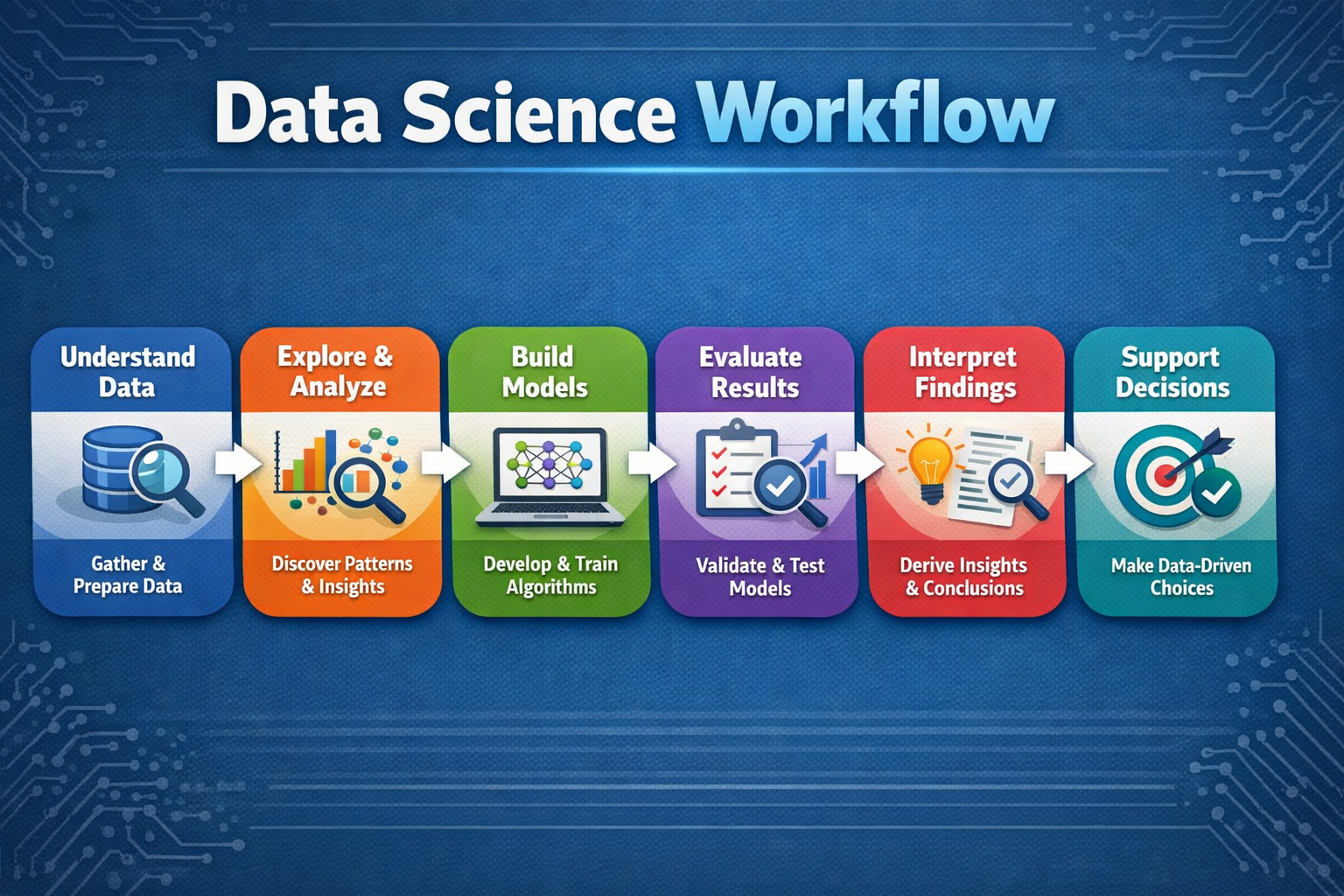
Stage 1: Understand Data
Start with:
- data structure
- variable types
- context of the problem
Understanding context is critical.
Stage 2: Explore and Analyze
Perform:
- exploratory data analysis
- summary statistics
- visualization
The goal is to understand patterns before modeling.
Stage 3: Build Models
Introduce models such as:
- regression
- classification
- simple predictive models
Focus on:
- correct setup
- appropriate model choice
- reproducible workflow
Stage 4: Evaluate Results
Evaluate using:
- appropriate metrics
- validation methods
- comparison across models
Avoid relying on a single metric.
Stage 5: Interpret Findings
This is the core of the role.
You must answer:
- what does the model tell us?
- what does it not tell us?
- what are the limitations?
This is where CDI interpretation discipline matters.
Stage 6: Support Decisions
Translate results into:
- recommendations
- insights
- decision support
The goal is not just modeling.
It is impact.
What Makes This Path Different
Compared to the Data Analyst role, this path:
- includes modeling
- includes inference
- goes beyond descriptive summaries
Compared to the ML Systems role, this path:
- focuses more on interpretation than deployment
- emphasizes reasoning before production systems
Readiness Within This Path
You are approaching readiness when:
- you can perform exploratory analysis independently
- you can build simple models
- you can evaluate results properly
- you can interpret outputs carefully
- you can explain findings clearly
Common Pitfalls
- jumping into models too early
- over-relying on metrics
- confusing correlation with causation
- ignoring assumptions
- over-interpreting results
CDI Perspective
At Complex Data Insights, data science is not just modeling.
It is interpretation with discipline.
From outputs to defensible claims.
What Comes Next
This role connects naturally to both:
- ML systems, for deployment and operation
- domain-specific paths, such as bioinformatics
The same career system applies across all.